
Your decisions about what, when and how you eat are key to managing diabetes. Here are some healthy eating options to consider.
3 healthy habits that make all the difference for diabetes
November 07, 2024
By Sun Life staff
You can manage or prevent type 2 diabetes with the help of a few key daily habits. Here’s how.

Reviewed by Dr. Josep Iglesies-Grau
Daily habits are key to the successful management of type 2 diabetes – and to treating prediabetes.
In fact, “it’s been proven that you can completely eliminate the development of this type of diabetes” with certain healthy habits, according to Dr. Martin Juneau.
Read more: Your diabetes support hub at Sun Life
Dr. Juneau is a cardiologist at the Montreal Heart Institute; he oversees the Institute’s Diabetes Prevention Clinic, sponsored by Sun Life.
Here are his three recommendations.
1. Eat healthy
Your diet plays an important role in managing diabetes.
A balanced plate is an excellent way to eat well while staying healthy.
Find a delicious balance
- Vary your foods: Go for diversity. Choose fruit, vegetables, and whole grains. Favour lean protein and low-fat or fat-free dairy products.
- Reduce sugar: Limit foods high in refined carbohydrates. Favour complex carbohydrates based on whole grains and legumes.
- Eat more fibre: Eat fibre-rich foods. This will slow down the absorption of sugar in the blood.
- Drink lots of water throughout the day.
Make your own meals
This will help you make healthy choices and stave off cravings.
- Cook at home: By cooking your own meals, you can control the ingredients and the amount of added salt, sugar, and fat.
- Read food labels carefully: Think about portion size and carbohydrates, sugar, sodium, and saturated fat content.
Drink water
Water is the healthiest drink.
To change things up, you can add a few drops of lemon or lime juice; or try herbal teas.
Also:
- Avoid carbonated and sugary drinks. Even fruit juices with no added sugar naturally contain large amounts of sugar.
- Limit your alcohol consumption. If you do have a drink, we recommend not doing so on an empty stomach. Don’t drink every day. Limit your consumption to the amount agreed on with your doctor.
A snapshot of Canada’s Food Guide
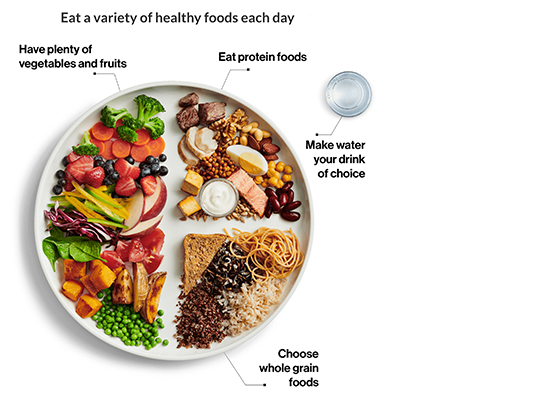
Source: Health Canada
The food guide snapshot has two main images. The first image shows a glass of water and a plate with food. This statement appears at the top:
Eat a variety of healthy foods each day.
There are four messages around the plate. They are:
- have plenty of vegetables and fruits
- choose whole grain foods
- eat protein foods
- make water your drink of choice
On half of the plate are vegetables and fruits (broccoli, carrots, blueberries, strawberries, green and yellow bell peppers, apples, red cabbage, spinach, tomatoes, potatoes, squash and green peas). On one-quarter of the plate are protein foods (lean meat, chicken, variety of nuts and seeds, lentils, eggs, tofu, yogurt, fish, beans). On the remaining one-quarter of the plate are whole grain foods (whole grain bread, whole grain pasta, wild rice, red quinoa, brown rice).
Courtesy of Health Canada
2. Get regular exercise
Lack of exercise can increase the risk of type 2 diabetes.
Like most people, you may already want to be more active. Just go for it!
The benefits of exercise in managing diabetes
Regular exercise is essential for preventing and treating type 2 diabetes.
It helps control weight and offers other benefits, even without weight loss:
- It reduces blood sugar levels,
- helps manage stress,
- decreases the risk of cardiovascular disease and
- may delay the need for medication.
Aim for daily physical activity
If you’re just starting out, ease into it slowly.
You can choose activities that are fun and fit your schedule.
- Aim for 150 minutes of moderate-intensity aerobic activity every week. This equates to about 30 minutes most days, broken down into 10- or 15-minute sessions.
- You can walk, swim, skate or play badminton – all excellent aerobic activities.
- Add muscle-strengthening exercises at least twice a week.
3. Learn to manage your stress
Stress can speed up your heart and raise your blood sugar. It’s important to learn how to manage it.
Try to change how you think and react
We can change the way we see and react to situations to improve our well-being.
Ask yourself:
- Are your reactions realistic?
- Do you express your needs clearly?
- Do you have a good support network?
- Do you take time to relax?
Diabetes can affect your mental health; if you feel you need it, seek the help of a specialist.
Managing and coming to terms with diabetes
Discovering that you have diabetes can be stressful. It’s a chronic disease that requires daily changes.
- Learn more about your disease. Get involved in your treatment. You’ll find it easier to manage your diabetes.
- Take the time to adapt and change your habits little by little.
- Seek help if necessary. Health professionals and your loved ones can support you.
These three lifestyle habits will help you better manage your blood sugar levels and prevent the complications of type 2 diabetes. (They can also lower the risk of developing type 2 diabetes.)
As a bonus, these habits will help you feel better and give you more energy.
This article is meant to provide general information only. It’s not professional medical advice, or a substitute for professional healthcare advice.