
It pays to stay invested when markets fall
By Sun Life Staff
Market downturns can be unsettling, but history shows that staying invested through the lows often leads to long-term gains. This article explores the benefits of maintaining your investment strategy during volatile times.

Stock markets are in a constant state of flux moving up, down and sideways. They don’t go straight up, but historically they have trended higher, bouncing back from shorter-term declines.
When markets start to fall, our instincts often tell us to sell. But if you sell when the market falls, you will crystalize losses and you’ll likely miss out on any market rebound and associated gains - meaning you may fall short of your long-term investment goals.
In stock market downturns, many investors are relieved to be on the sidelines. If we look back at the chart below, illustrating the largest component of the stock market the S&P 500, imagine what could have happened if you ignored the dramatic headlines and had simply stayed invested.
S&P 500 Index Performance (1995–2024)
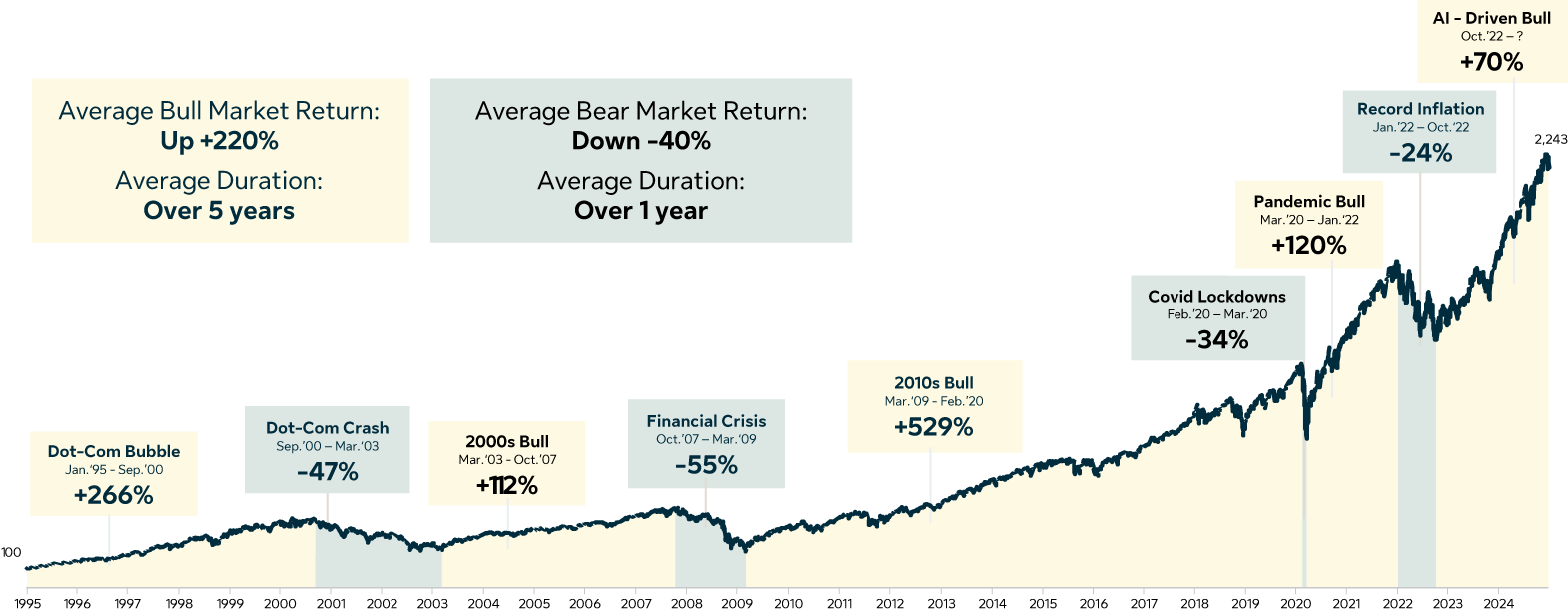
Stock market returns represented by the S&P 500 Index. Source: Morningstar, SLGI Asset Management Inc
A line graph illustrating the performance of the S&P 500 Index from 1995 to 2024, highlighting key market events:
- Dot-Com Bubble (Jan 1995–Sep 2000): +266%
- Dot-Com Crash (Sep 2000–Mar 2003): -47%
- 2000s Bull Market (Mar 2003–Oct 2007): +112%
- Financial Crisis (Oct 2007–Mar 2009): -55%
- 2010s Bull Market (Mar 2009–Feb 2020): +529%
- COVID-19 Lockdowns (Feb 2020–Mar 2020): -34%
- Pandemic Bull Market (Mar 2020–Jan 2022): +120%
- Record Inflation (Jan 2022–Oct 2022): -24%
- AI-Driven Bull Market (Oct 2022–?): +70%
The graph emphasizes that, historically, bull markets have lasted over five years with average returns of +220%, while bear markets have lasted over one year with average declines of -40%.
This example is for illustrative purposes only and is not intended to be representative of the performance of any actual or future investment available to investors.
It is not possible to invest directly in an index. Returns are calculated in U.S. dollars and assume reinvestment of all income and no transaction costs or taxes for the period January 1, 1985 to December 31, 2024. Actual returns would be different due to fees and expenses associated with investing which are not applicable to an index. For purposes of this illustration, a bear market is defined as an index falling at least 20% from a previous high.
Time in the market is time well-spent
Historically, bull markets have lasted 4 times longer than bears and driven long-term gains. When markets start to fall, our instincts often tell us to sell now and buy again later. That may seem logical, but how do you pick the right time to exit or re-enter the market? Because rallies can sometimes come in surges measured in days not weeks, being out of the market for even a few days can mean missing out on gains.
Missing the best days can hurt
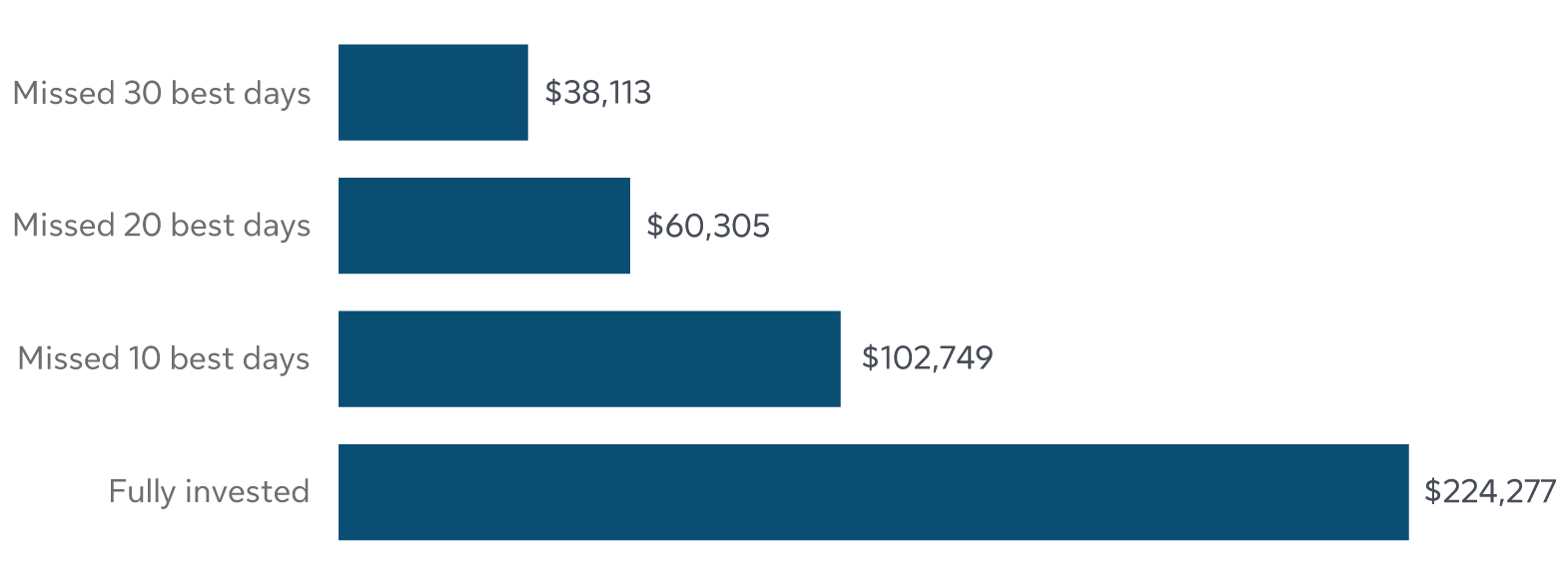
Source: Morningstar Direct. Daily data as of December 31, 2004 through December 31, 2024.
A bar chart showing the growth of a $10,000 investment in the S&P 500 Index over 20 years ending December 31, 2024:
- Fully invested: $224,277
- Missed 10 best days: $102,749
- Missed 20 best days: $60,305
- Missed 30 best days: $38,113
This illustrates the significant impact that missing just a few of the market's best days can have on long-term investment returns.
For illustrative purposes only. Returns have been rounded to the nearest whole number for simplicity. Past performance is no guarantee of future results. It is not possible to invest in an index. Index performance does not include any investment-related fees or expenses.
Analysis ranks all daily returns and investors that miss out on those returns simply do not grow their investment by that return for that particular day. If the following day does not fall into a range that they are meant to miss, then the growth of the investment resumes.
No securities commission or similar regulatory authority in Canada has reviewed this communication.
When the markets fall, it pays to stay focused on your long-term investment goals.
Get professional advice
We offer advice to help you navigate through challenging times.
Please call a licensed Financial Services Consultant1 today (Monday to Friday, 8 a.m – 8 p.m. ET.).
- If you are in an employer group plan call: 1-866-634-4840
- If you are in a Choices plan call: 1-877-805-9303
We’re here for you
Our commitment to helping you manage uncertainty is unwavering. You can count on us.
Over our 160-year history, we’ve navigated through complexity with adaptability and resilience. We focus on what truly matters: helping Canadians achieve lifetime financial security and live healthier lives.
1 Registered as financial securities advisors in Quebec.
This article is meant to provide general information only. Sun Life Assurance Company of Canada does not provide legal, accounting, taxation, or other professional advice. Please seek advice from a qualified professional, including a thorough examination of your specific legal, accounting and tax situation.
© Sun Life Assurance Company of Canada. All rights reserved.