
June 9, 2025
Seizing opportunities during market volatility
By Sun Life Staff
Market volatility can present unique investment opportunities. This article explores strategies to capitalize on market fluctuations and strengthen your investment portfolio.

Market volatility can feel like a rollercoaster ride for investors, with sharp ups and downs that spark uncertainty. Yet, for those with a long‑term perspective, these fluctuations can present unique opportunities to build wealth. At Sun Life, we believe that understanding volatility and approaching it strategically can help you turn market turbulence into a chance to strengthen your portfolio. Here’s how you can navigate and capitalize on volatile markets.
What is market volatility?
Volatility refers to the rapid and often unpredictable changes in the prices of investments, such as stocks, bonds, or mutual funds. It’s driven by factors like economic shifts, geopolitical events, interest rate changes, or even investor sentiment. While volatility can be unsettling, it’s a normal part of investing. Historically, markets have weathered periods of turbulence – think of the 2008 financial crisis or the 2020 COVID‑19 market drop – and still delivered long‑term growth for those who stayed the course.
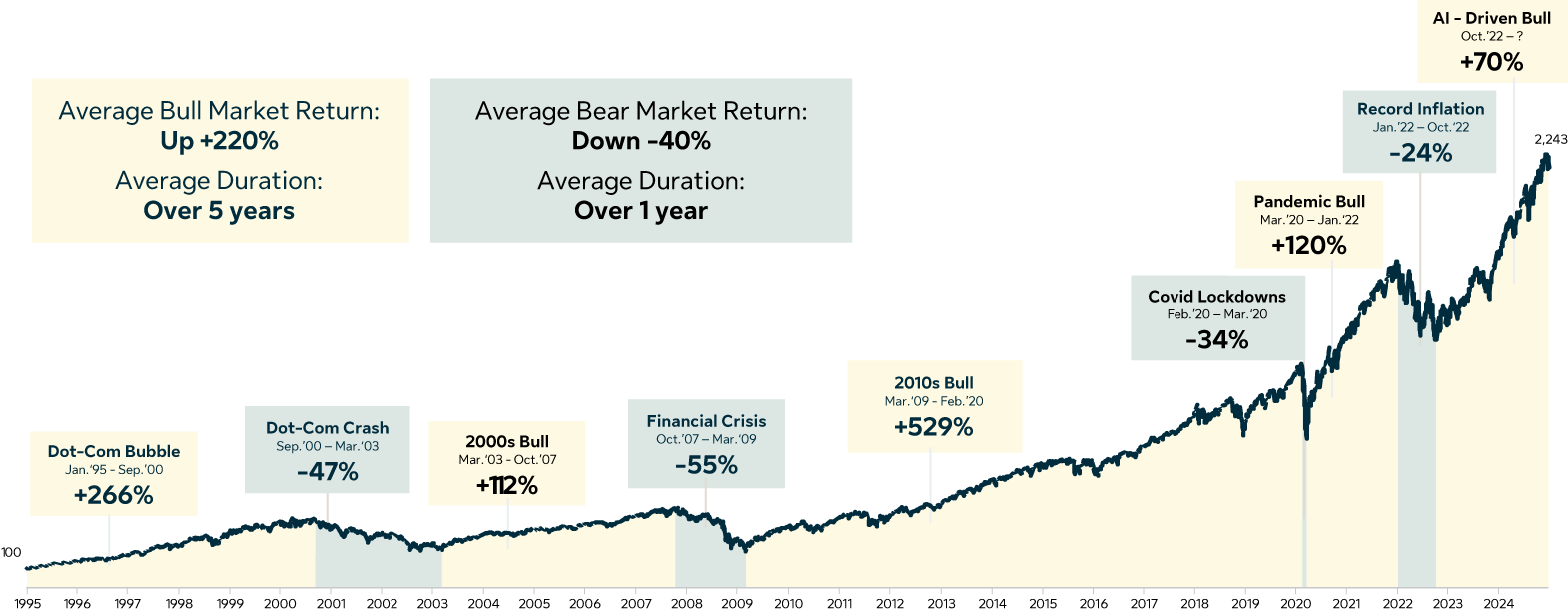
Stock market returns represented by the S&P 500 Index. Source: Morningstar, SLGI Asset Management Inc.
The infographic illustrates the concept of dollar-cost averaging and its benefits during volatile markets. It compares two investment strategies over a period of declining and then recovering market prices:
- Lump-Sum Investment: Investing a large amount at the beginning of the period, resulting in purchasing fewer shares at higher prices and experiencing greater impact from market downturns.
- Regular Interval Investments: Investing smaller amounts at regular intervals, leading to purchasing more shares when prices are low and fewer when prices are high, thereby averaging out the cost per share over time.
The visual demonstrates that regular interval investments can lead to better outcomes in volatile markets by reducing the average cost per share and potentially enhancing returns during market recoveries.
This example is for illustrative purposes only and is not intended to be representative of the performance of any actual or future investment available to investors. It is not possible to invest directly in an index. Returns are calculated in U.S. dollars and assume reinvestment of all income and no transaction costs or taxes for the period January 1, 1985 to December 31, 2024. Actual returns would be different due to fees and expenses associated with investing which are not applicable to an index. For purposes of this illustration, a bear market is defined as an index falling at least 20% from a previous high.
Opportunities in volatile markets
Rather than fearing volatility, consider it a window of opportunity. Here are some ways to make the most of market fluctuations:
1. Buy low during market dips
When markets dip, quality investments often become available at discounted prices. This is a chance to buy fundamentally strong assets – such as stocks of well‑established companies or diversified investment funds – at a lower cost. For example, during periods of market correction, you might pick up shares of a company with solid earnings or investment funds that are available in your Sun Life plan at a more attractive price. Over time, as markets recover, these investments could appreciate significantly.
2. Dollar‑cost averaging for steady growth
Volatility can make it tricky to time the market, but dollar‑cost averaging offers a disciplined approach. By investing a fixed amount regularly – for example, monthly into a Sun Life Granite Target Date Fund – you can buy more units when prices are low and fewer when prices are high. This strategy can potentially reduce the average cost per unit over time, smoothing out the impact of market swings and positioning you for long‑term gains.
3. Diversify to manage risk
Diversification remains a cornerstone of investing, especially in volatile times. Spreading your investments across asset classes (stocks, bonds, cash) and regions can help cushion the impact of market drops. For instance, while equities may face sharp declines, bonds or guaranteed investment certificates (GICs) can provide stability. A diversified portfolio, like one built with Sun Life’s target risk funds, balances growth potential with risk management, helping you weather market storms.
4. Focus on quality investments
Volatile markets reward those who invest in quality. Look for companies or funds with strong fundamentals, such as consistent earnings, low debt, or a track record of resilience. These types of investments are more likely to rebound and thrive as markets stabilize, offering both growth and stability.
5. Stay invested for the long term
One of the biggest mistakes investors make during volatility is selling in a panic. History shows that markets tend to recover over time, often reaching new highs after downturns. For example, after the steep declines of early 2020, global markets rebounded strongly by 2021. Staying invested – whether in a registered retirement savings plan (RRSP), a tax‑free savings account (TFSA) or a non‑registered account with Sun Life – allows you to ride out short‑term fluctuations and benefit from long‑term growth.
Practical steps to get started
To turn volatility into opportunity, consider these actionable steps:
Work with us
Through your plan, our team can help you assess your risk tolerance, refine your investment strategy, and identify opportunities tailored to your goals. They can recommend products and help you keep on track – offering peace of mind in turbulent times.
Explore conservative options
If volatility feels overwhelming, consider low‑risk options like Money Market Funds, which focus on capital preservation while offering modest income. This can act as a safe haven while you wait for the right moment to invest in higher‑growth assets.
Rebalance your portfolio
Volatility can shift your asset allocation. Volatile times offer an opportunity to regularly review and adjust your portfolio to ensure it aligns with your risk profile and objectives. For example, if equities drop significantly, you may want to rebalance by adding to your stock holdings at lower prices.
Stay informed, not overwhelmed
Keep up with market trends through trusted sources, but avoid reacting to every headline. Focus on your long‑term plan rather than short‑term noise.
Why volatility isn’t the enemy
It’s natural to feel uneasy when markets swing, but volatility is part of the journey to building wealth. By staying disciplined, diversifying your investments, and seizing opportunities like buying on dips or using dollar‑cost averaging, you can turn market turbulence to your advantage. At Sun Life, we’re here to help you navigate these challenges with confidence. Ready to make volatility work for you? Connect with us today to explore personalized strategies and start building a stronger financial future, no matter what the markets bring.
Get professional advice
We offer advice to help you navigate through challenging times.
Please call a licensed Financial Services Consultant1 today (Monday to Friday, 8 a.m – 8 p.m. ET.).
- If you are in an employer group plan call: 1-866-634-4840
- If you are in a Choices plan call: 1-877-805-9303
We’re here for you
Our commitment to helping you manage uncertainty is unwavering. You can count on us.
Over our 160-year history, we’ve navigated through complexity with adaptability and resilience. We focus on what truly matters: helping Canadians achieve lifetime financial security and live healthier lives.
1 Registered as financial securities advisors in Quebec.
This article is meant to provide general information only. Sun Life Assurance Company of Canada does not provide legal, accounting, taxation, or other professional advice. Please seek advice from a qualified professional, including a thorough examination of your specific legal, accounting and tax situation.
© Sun Life Assurance Company of Canada. All rights reserved.