Client spotlight: Montreal Port Authority - repeat buy-ins

The right annuity transaction can protect the plan, the retirees, and the organization
About Montreal Port Authority
The Port of Montreal is Eastern Canada’s largest port and the second largest port in Canada. Located at the heart of North America, it covers 26 km of shoreline and sees over $100 billion worth of cargo per year.
Montreal Port Authority (MPA), the organization in charge of the port’s activities, has 275 employees and helps facilitate 19,000 jobs directly and indirectly. MPA has a closed defined benefit (DB) pension plan that has become more mature in recent years.

Nadia Ivanova
Nadia joined MPA as Head of Treasury & Investments in February 2021 and was promoted to Director, Analysis, Planning and Treasurer in March 2022.
Earlier this year, Nadia sat down with us to discuss MPA’s repeated group annuity transactions. She highlighted why purchasing annuities is an important part of MPA’s strategy to reduce pension risk.
The drivers
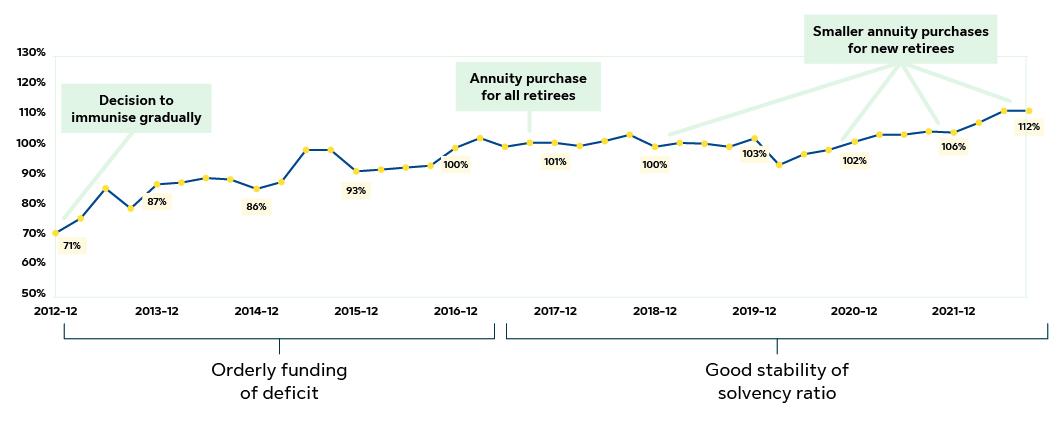
In 2012, MPA’s DB plan was in a significant solvency deficit. To fund the deficit, MPA had to make large special payments. This became concerning for both management and board members and kicked-off MPA’s pension de-risking journey. The first task was to find the right partners and solutions for their specific needs.
Montreal Port Authority’s de-risking journey
“The reality is a lot of defined benefit plan sponsors are not in the pension business. We want to turn these liabilities over to companies whose core competency is to manage long-term liabilities – without any detriments to the plan participants and retirees.” – Nadia Ivanova
Read about West Fraser's de-risking journey
The strategy
MPA partnered with actuarial consulting firm Normandin Beaudry to help guide them on their de-risking journey. Normandin Beaudry pointed to two key elements that helped ensure MPA’s success with annuity purchases.
- Evolved the investment strategy and asset mix.
- Gradually reduced exposure to volatile risky assets and transferred them to more liability matching assets.
- Introduced a bond overlay.
- Improved the interest rate hedge ratio, which helped improve the solvency ratio.
- Introduced real return bonds in the portfolio
- Protected the plan from inflation risk.
- Trained stakeholders.
- Ensured every stakeholder, from management to board members, understands the transaction and are comfortable with it.
- Documented governance .
- MPA created a document outlining the governance framework, market monitoring, factors that indicate when to go to market, and decision criteria to move forward with the transaction.
- Secured Board approvals
- A group annuity purchase is an irreversible transaction, so necessary approvals were paramount.
- Monitored the annuity market
- Continuous market monitoring ensured the best timing for the transaction..
- Prepared for the transaction
- Held a simulation or mock transaction day with Normandin Beaudry.
- Tested triggers in the annuity purchasing process to ensure a successful transaction ahead of quote day.
“Don’t be afraid to ask questions and reach out to your partners.” - Nadia Ivanova
The transactions
In 2017, MPA prepared for the transaction in the first half of the year and came to market in August. They completed their first purchase of a consumer price index (CPI)-linked annuity for $150 million dollars. This group annuity effectively protected the entirety of the retiree population at the time.
Four more transactions took place between 2018 and 2022. Each transaction was an annuity buy-in and transaction sizes varied between $8 million and $30 million. The buy-in transaction structure allowed MPA to create a seamless experience for the 400 protected annuitants.
“For years now, employers sponsoring pension plans have been purchasing annuities from insurers, thus, reducing the plans’ assets and liabilities, while simultaneously strengthening the company’s balance sheet.” – Nadia Ivanova
Trust the experts
Since pension plans can fluctuate with market volatility and interest rates, annuity purchases have become a key tool in MPA’s risk management strategy. By transferring the risk to pension experts, DB plan sponsors can free up time to focus on their core business and ensure financial security for annuitants. Mutual trust, relying on the process, the right advisors and partners are important to ensuring successful transactions.
A bright future
The appropriate timing for a transaction can help solidify the plan’s financial position, and protect the plan, the retirees, and the company. MPA continuously monitors the market with their consultants, allowing them to choose the best moments to de-risk.