

I’m sure you’ve heard about how important a financial plan is. But what exactly is a financial plan? Is it something akin to a vision board with dreams for retirement? An Excel spreadsheet? A legal document? Something you dread talking about?
Well, it’s not any of those things. Sure, it’s a physical thing... But it’s also something that isn’t the same for everyone. It’s unique to you – and adapts with you.
A financial plan is an essential planning tool for your financial well-being, today and tomorrow. It involves documenting your finances, your goals, and the ways you can help achieve them.
It’s important to note that only an advisor with a Certified Financial Planner (CFP) designation can help create a financial plan with you. Many Sun Life advisors are Certified Financial Planners.
Let’s break it down a bit.
What is a Certified Financial Planner?
The most widely recognized financial planning designation in Canada and worldwide is the Certified Financial Planner (CFP).
To get a CFP designation, an advisor must:
- complete an education program,
- pass a national exam,
- have a post-secondary degree, and
- demonstrate three years of qualifying work experience.
Then, to maintain their designation, CFP professionals must:
- complete continuing education each year, and
- adhere to standards and ethics ensuring they place a Client’s interests first.
How do you start a financial plan?
A good plan starts with a CFP getting to know you and what makes you unique. They may ask you questions like:
- What are your financial needs today, at retirement and beyond?
- What do you already have in savings, investments, insurance and benefits?
- Does what you have measure up against what you want?
- Is there a plan to help you get there?
Once the CFP understands what matters to you, they can help you:
- build your plan,
- explore your options, and
- implement the solutions you choose.
How is a financial plan built?
When building a financial plan, CFPs often refer to a tool called a priority pyramid or financial planning pyramid. At its base is your financial plan and the legal documents like a will or powers of attorney. With a clear plan in mind, it’s much easier to work toward realizing your financial goals. Just like a pyramid is built on a solid base, it’s important to provide a solid base for your financial future. And that starts with a clear plan.
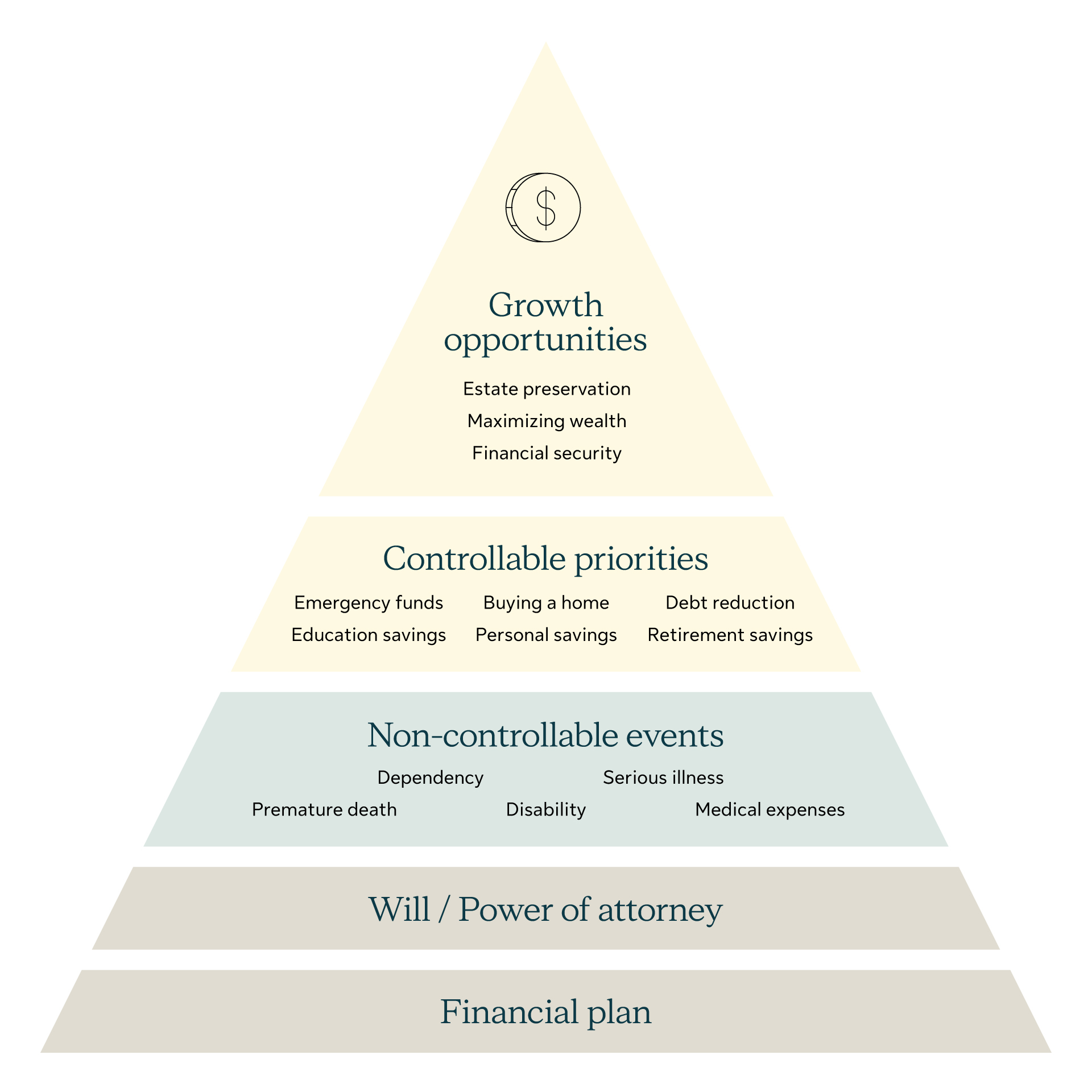
When building a financial strategy, where do you begin? It’s a good idea to start by looking at the events in your life that you can’t control, or non-controllable events. This helps ensure you have the right protection in place if something happens. Risks can harm our earning ability to meet our lifestyle expenses, for example:
- Becoming dependent
- Unexpected medical expenses
- Dying prematurely
- Suffering a serious illness
- Becoming disabled
Next, consider your controllable priorities. These are things you can plan for, and goals you want to achieve, like:
- Buying a home
- Saving for retirement
- Saving for your child’s education
- Reducing debts
- Having emergency cash on hand
- Savings – to have some fun along the way
Finally, you consider growth opportunities. Having looked after your financial foundation, you can now take some calculated risks to potentially leverage your savings. And by building it this way, you can make well-informed investment decisions.
Building your plan this way helps ensure what you put together stays together.
What does a financial plan include?
Financial plans aren't one-size-fits-all. However, most include many of the same key elements, including:
- Documented goals
- Your planning preferences
- Savings and investments
- Emergency savings plan
- Retirement plan
- Risk management
- A long-term investment strategy
- A tax minimization plan
- Life and health insurance coverage
What’s included in your financial plan depends on you and your unique experience.
Is a financial plan only for people who have money?
No. There's a common misconception that financial planning is only for the wealthy. Don’t let your income or bank balance stop you from working with a CFP to create a plan. The objective of financial planning is to help get you to your desired goals. It doesn’t matter when you start or how much money you have when you do. All that matters is how and when you reach those goals.
What can a financial plan help give you?
A comprehensive financial plan can give you peace of mind. It gives you something concrete that shows you in one place how you’re tracking toward your goals.
We asked a CFP, what it’s like walking Clients through the financial planning process. He explains, “The plan becomes a living document that shows you how you’re progressing toward your goals. Clients say they feel like they’re moving forward and being taken care of.”
Life is full of ups, downs, and unknowns. So, it’s reassuring to have something tangible to refer to and keep you motivated.
Can I have a financial plan in my 20s?
You absolutely can have a financial plan in your 20s. Despite what you’re hearing on social media – your financial future isn’t doom and gloom. You can control more than you might realize. And it starts with a plan. And one that works for you – and the economy you’re growing up in (not your parents).
Take Sonia* for example. She tells us, “I got my first financial plan when I was 23. I had recently graduated university and was early in my career. I had ambitions of buying my first home. So, I met with a recommended CFP.” She explains that while she went through the process of creating a financial plan, the CFP had some great advice. “He said ’If you save part of your paycheque now, as you’re starting out, you won’t even miss the money.’ And he was right,” Sonia explains. “I was new to having a regular paycheque. So, that percentage I put into my TFSA and RRSP? It didn’t feel like a sacrifice.” She continues, “What if I’d waited until I was reliant on my pay being a certain amount – and spent accordingly? It would have been much harder to adjust to saving.”
The plan paid off. “18 months after our first meeting with our CFP, my husband (boyfriend at the time) and I bought our first home. We took advantage of our Home Buyers’ Plan (HBP) and TFSA withdrawals to do so.”
As part of the planning process, Sonia applied for and bought a permanent life insurance policy. “It seems wild to me now that I didn’t have dependents or a mortgage. And yet, I considered life insurance. But through the financial planning process, I saw that paying for my policy while I was young meant I’d have one less thing to worry about later.” Flash forward to today, she’s under 40 and responsible for 2 young kids and a mortgage. “I’m glad I have the right coverage in place. It’s there to help protect my family if I die while they rely on my income.”
And the planning hasn’t really stopped for her, either. Sonia concludes, “Over the years, we’ve expanded our family, bought and sold homes, and changed jobs. And we’ve adjusted our financial plan along the way.”
What happens if you don’t have a plan?
Are you worried you’re condemned to working forever and forgoing retirement if you don’t have a plan? It’s ok; you can start at any time with the help of CFP designated advisor.
"Our goal is to equip every Sun Life Client across Canada with a financial plan," said Rowena Chan, President, Sun Life Financial Distributors (Canada) Inc. and Senior Vice-President, Distribution. "A financial plan, combined with Sun Life's ability to provide holistic advice, makes it easier for Canadians to grow and protect their finances. Having a plan in place builds confidence and provides simple, clear steps towards achieving wealth, health, and protection goals."
Is it too late to get a financial plan in my 40s or 50s?
It’s never too late to create a financial plan. Marie*, a single mom of 2 teenagers, was happy to hear it. At 45, she wonders if she’s missing out by not having a plan. “I have RRSPs, TFSA, RESPs and a life insurance policy. All of the important legal paperwork like a will, guardianship and power of attorney are in order. But I don’t have a clear path into the next chapter of my life. I wonder: When could I reasonably hope to retire? Can I one day buy a small home outside of the city? Will I be able to pay for my kids’ schooling? And will I run out of money in retirement? These are all important questions!”
Even when you’re in your 50s, you still have a decade or two of your highest income-earning years ahead of you. So, now would be a great time to start planning.
When do you revisit your financial plan?
It’s a good idea to re-visit your financial plan annually or semi-annually. But if that isn’t possible – at the very least you must revisit your plan at these moments:
- When you get a new job. Especially one that changes your income, expenses, or opportunities.
- If you have a change in income. This might be one that affects your ability to pay your expenses, pay off debt, or save.
- At any major life event that might change financial goals and spending habits (i.e. marriage, children, or divorce).
- If you have a health event that causes you to re-direct your income and spending away from your goals.
- If you receive an inheritance or insurance payment.
Who can help me get a financial plan?
A Certified Financial Planner (CFP) is the only professional who can create a financial plan with you.
* Names have been changed for privacy.
This article is meant to provide general information only. Sun Life Assurance Company of Canada does not provide legal, accounting, taxation, or other professional advice. Please seek advice from a qualified professional, including a thorough examination of your specific legal, accounting and tax situation.